LAYER 1: EXECUTIVE CONTEXT (Cody\ s Notes)
Cody's Notes
Great article on the unavoidable fact that development is a winding road to the right answer, and we have to pivot when we learn more.
This is a great paragraph from the article:
"In contrast, the strong teams are very good at quickly determining the good ideas from the bad (no matter where that idea originated), and are very fast at iterating to a strong and effective solution. This is called product discovery. This is why I view product discovery as the most important core competency of a product organization. If we can prototype and validate ideas with customers, engineers and stakeholders in days rather than months, it changes both the dynamics and the results."
So be intentional about FAILING FAST!!! Run your tests intentionally. To test yourself, ask "am I 100% certain what we are going to build will solve the problem?". If there is still doubt, sit down and create a test to validate or invalidate your assumption. That's far cheaper and faster.
Remember this quote: "If you knew you were 30 failures away from your goal, how fast would you want to fail?"
Bonus: the Lean Startup is a great book about rapid tests. Forget that it's a startup. Holds true regardless.
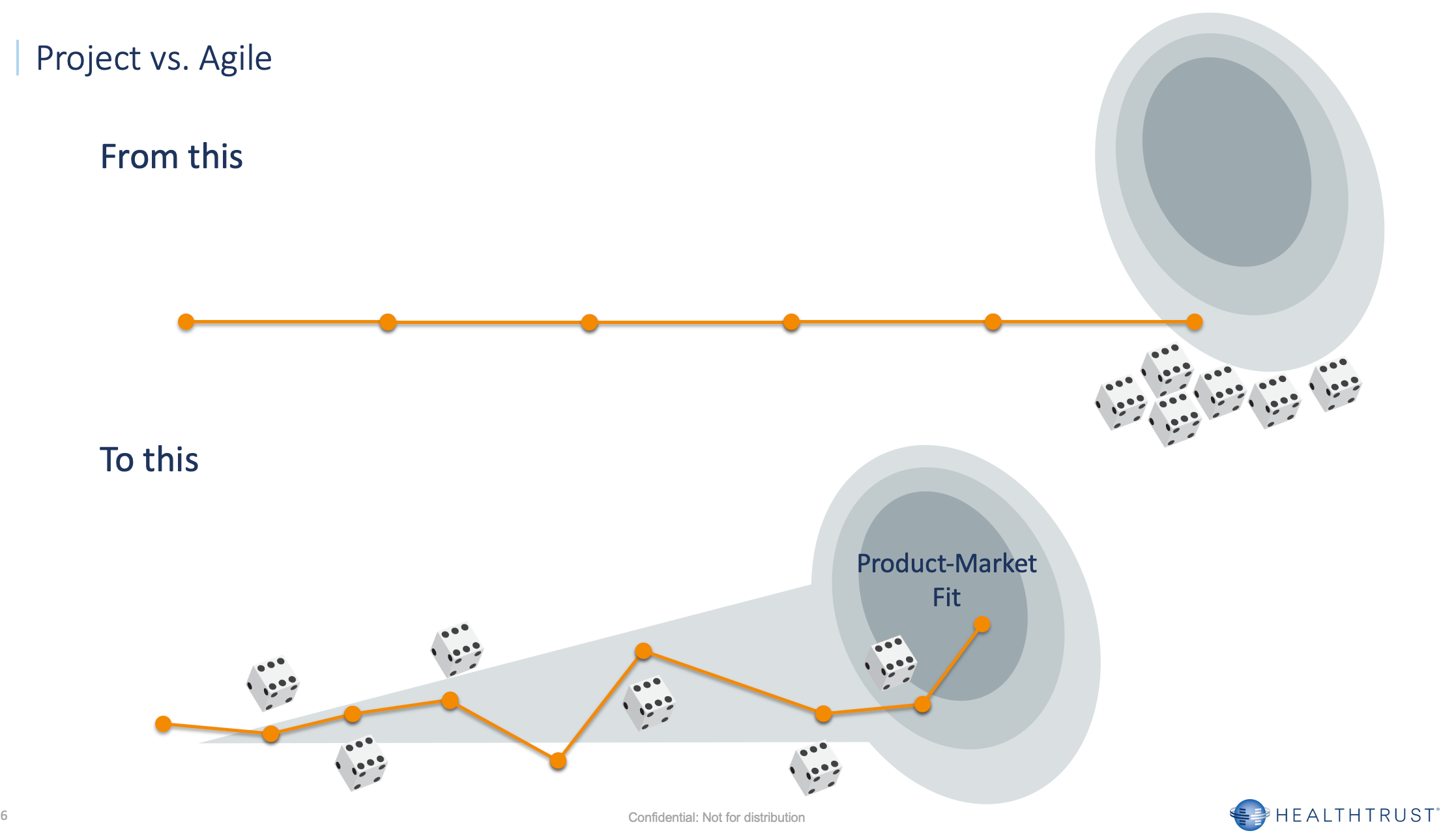
One of my old slides that shows the uncertain path. but with discovery done right, it's faster and on target:
LAYER 2: CORE PHILOSOPHY (The Narrative Summary)
Core Philosophy
There are two "inconvenient truths" in product: 1) At least half of our ideas are not going to work, and 2) Those that do work will take several iterations to achieve the necessary business value.
1. The Failure of the Waterfall Roadmap
- Presumptive Value: Traditional roadmaps assume ideas are valuable and feasible from the start, leading to wasted engineering effort on things customers don't want or can't use.
- Four Big Risks: Most ideas fail because they miss one of the four big risks: Value, Usability, Feasibility, and Business Viability.
2. The Role of Product Discovery
- Rapid Separation: The goal of discovery is to quickly and cheaply separate the good ideas from the bad through iteration.
- Outcome Focus: Success should be measured by business outcomes and value created, rather than the volume of features shipped.
Quick Reference Checklist
- Are we testing at least 10-20 iterations/ideas per week?
- Have we identified the "riskiest assumption" for our top priority?
- Is the team empowered to "kill" an idea that doesn't show value in discovery?
- Are we measuring success by business outcomes rather than feature shipping?
Generated for the Product Leadership Growth Program.
LAYER 3: FULL REFERENCE (Raw Article Content)
Source: The Inconvenient Truth About Product
Every week I continue to find product teams laboring away on old-style product roadmaps that have been painstakingly negotiated with management and stakeholders, sometimes for several quarters in advance. I have written several times about the problems with this approach and why it so seldom results in the business impact that the organization was hoping for (see The Opportunity Backlog and Product Roadmaps).
In this article I wanted to shine a light on the underlying reason why, even with the best of intentions, these roadmaps typically lead to very poor business results.
I have begun referring to these reasons as “the two inconvenient truths about product.”
The first such truth is that at least half of our ideas are just not going to work. There are many reasons for an idea to not work out. The most common is that the customers just aren’t as excited about this idea as we are. So they choose not to use it. But sometimes they want to use it, but it’s so complicated that it’s simply more trouble than it’s worth, which yields the same result – the users don’t choose to use it. And sometimes the issue is that the customers would love it but it turns out to be much more involved to build than we thought, and we simply can’t afford the time and money to deliver.
If that’s not bad enough, the second inconvenient truth is that even with the ideas that do prove to be valuable, usable and feasible, it typically takes several iterations to get the implementation of this idea to the point where it actually delivers the expected business value.
In my experience, there simply is no escaping these inconvenient truths. And I’ve had the opportunity to work with many truly exceptional product and technology people. The real difference is how you deal with these truths.
The weak teams just plow through the roadmap month after month, and when something doesn’t work, first they blame it on the stakeholder that demanded the feature, then they try to schedule another iteration on the roadmap, or another redesign, or another set of features that this time they hope will solve the problem. If they have enough time and money, they can eventually get there as long as management doesn’t run out of patience first.
In contrast, the strong teams are very good at quickly determining the good ideas from the bad (no matter where that idea originated), and are very fast at iterating to a strong and effective solution. This is called product discovery. This is why I view product discovery as the most important core competency of a product organization. If we can prototype and validate ideas with customers, engineers and stakeholders in days rather than months, it changes both the dynamics and the results.
If you still think that you or anyone else in your organization can envision this beautifully working solution from the outset, then I encourage you to look deeper. I promise you that behind every successful product there are many iterations and prototypes.
So rather than fight them, embrace these two inconvenient truths. Become great at product discovery.
Generated for the Product Leadership Growth Program.